
The Future of Scalable Software Architecture in Enterprise Environments
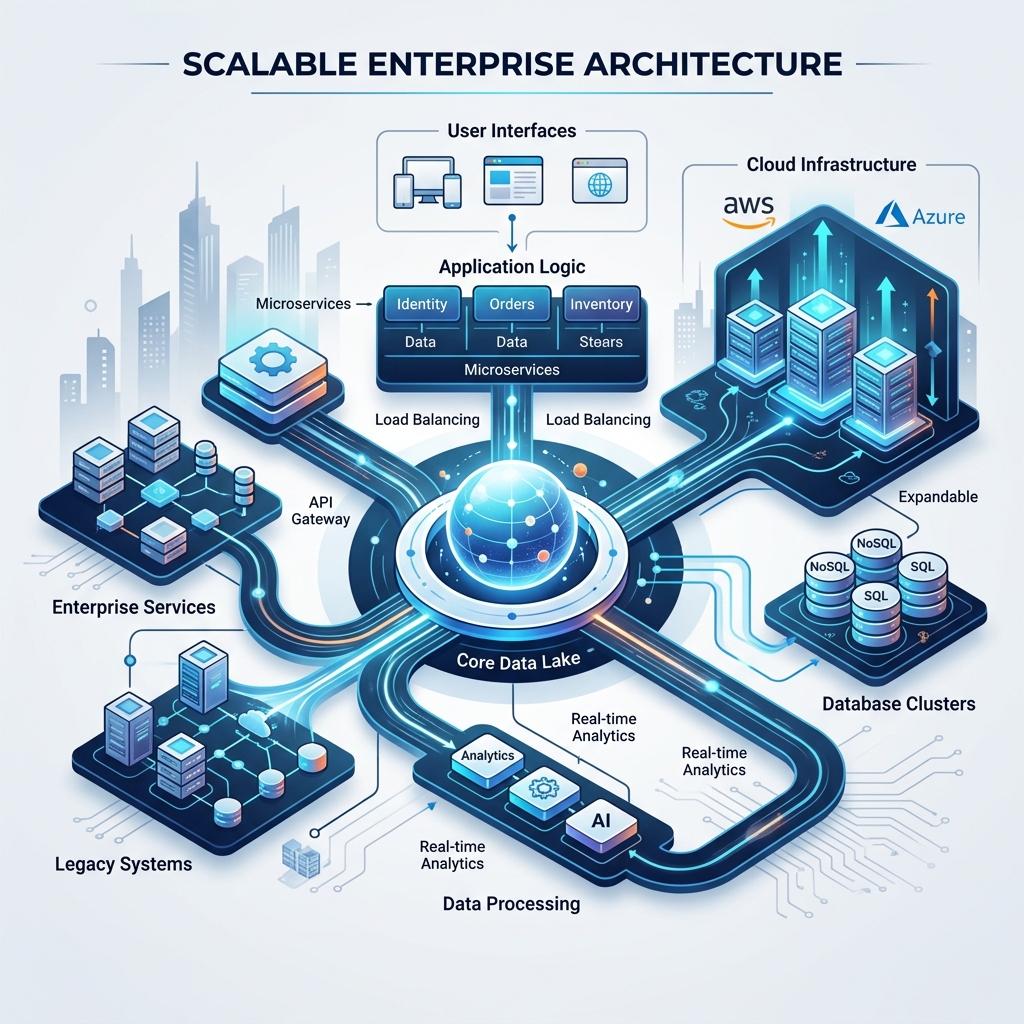
The enterprise software landscape has experienced a monumental paradigm shift over the past decade. Driven by the relentless need for agility, global reach, and the ability to handle unprecedented volumes of data, software architecture has evolved from rigid, monolithic structures into highly distributed, dynamic ecosystems. As we look towards the future, the concept of scalability is no longer just about adding more servers to handle increased load; it is about designing intelligent, resilient systems that can autonomously adapt to changing conditions, self-heal in the face of failures, and deliver consistently high performance on a global scale. In this deep dive, we will explore the key trends, technologies, and methodologies that are shaping the future of scalable software architecture in enterprise environments.
To understand the trajectory of software architecture, it is essential to first recognize the underlying forces driving this evolution. The digital transformation imperative has forced organizations to innovate at breakneck speeds. Customers expect real-time interactions, seamless cross-platform experiences, and zero downtime. Furthermore, the sheer volume, velocity, and variety of data generated by modern applications demand architectural paradigms that can process, analyze, and act upon this data in near real-time. The traditional boundaries of the data center have dissolved, replaced by the expansive, nebulous capabilities of the cloud.
1. Beyond Microservices: The Evolution of Distributed Systems
Microservices have undeniably revolutionized enterprise architecture by decomposing unwieldy monoliths into smaller, independently deployable, and loosely coupled services. This approach has drastically improved developer velocity, enabled polyglot programming environments, and allowed teams to scale specific components of an application independently based on demand. However, the future is moving beyond the basic implementation of microservices towards more refined and sophisticated distributed systems.
One of the primary challenges of microservices is managing the intricate web of communication between them. As the number of services grows exponentially, issues like network latency, fault tolerance, and security become increasingly complex. The future of scalable architecture relies heavily on the maturation of Service Meshes. A service mesh, such as Istio or Linkerd, abstracts the communication layer away from the application code, providing a dedicated infrastructure layer for managing service-to-service communication. This allows developers to focus purely on business logic while the mesh handles critical cross-cutting concerns like load balancing, service discovery, encryption (mTLS), and fine-grained access control.
Furthermore, we are witnessing a shift towards "macroservices" or "right-sized services." Organizations have realized that arbitrarily splitting a monolith into hundreds of nano-services often introduces unnecessary complexity and operational overhead. The future emphasizes finding the optimal boundaries for services—often aligned with Domain-Driven Design (DDD) bounded contexts—striking a balance between agility and manageability.
2. The Ascendancy of Serverless Computing and FaaS
Serverless computing, and more specifically Function-as-a-Service (FaaS), represents the next logical step in the evolution of cloud computing. In a serverless architecture, the cloud provider dynamically manages the allocation and provisioning of servers. Developers simply write and deploy code (functions) that execute in response to specific events or triggers. The billing model is purely consumption-based; you only pay for the exact compute time your code consumes, down to the millisecond.
For enterprise scalability, serverless is a game-changer. It offers inherent, virtually infinite scalability. When a massive spike in traffic occurs, the cloud provider automatically spins up thousands of concurrent instances of a function to handle the load, scaling back down to zero when the traffic subsides. This eliminates the need for complex auto-scaling configurations and capacity planning.
However, the future of serverless is not without its challenges. Issues like "cold starts" (the latency introduced when a function is invoked after a period of inactivity), state management, and vendor lock-in remain concerns. Future architectural patterns will increasingly leverage hybrid approaches—combining long-running, stateful containerized applications (often managed by Kubernetes) with serverless functions for event-driven, ephemeral workloads, creating a best-of-both-worlds scenario.
3. Event-Driven Architecture (EDA) as the Nervous System
As systems become more distributed, synchronous, request-response communication patterns (like REST) often become bottlenecks. If Service A must wait for Service B to respond before it can proceed, the entire system's performance is limited by its slowest component, and a failure in one service can cascade and bring down the whole application.
The future of enterprise architecture is overwhelmingly asynchronous and event-driven. In an Event-Driven Architecture (EDA), services communicate by emitting and reacting to events—significant changes in state. This decoupling allows services to operate independently and autonomously. A service emitting an event does not need to know which services, if any, are listening to it.
Technologies like Apache Kafka, RabbitMQ, and cloud-native event buses (like AWS EventBridge) form the central nervous system of modern enterprises. They facilitate high-throughput, low-latency, and durable message routing. EDA enables real-time data processing, complex event processing (CEP), and ensures eventual consistency across distributed data stores. It allows systems to absorb massive spikes in traffic gracefully by queuing events for processing when resources are available, rather than failing synchronously.
4. Edge Computing: Pushing Logic to the Periphery
Historically, cloud computing has been highly centralized, with data flowing from the user to massive, remote data centers for processing, and then back again. While this model offers immense computing power, it introduces unavoidable network latency, which is unacceptable for applications requiring real-time responsiveness, such as autonomous vehicles, augmented reality (AR), and high-frequency trading.
Edge computing addresses this by pushing computation and data storage closer to the location where it is needed—the "edge" of the network, closer to the user or the IoT device generating the data. By processing data locally, edge computing drastically reduces latency, conserves bandwidth, and improves reliability, as the application can continue to function even if connectivity to the central cloud is temporarily lost.
The scalable architecture of the future will be a seamless continuum from the centralized cloud to the decentralized edge. Cloud providers are increasingly offering edge-native services (like AWS Wavelength or Cloudflare Workers), enabling developers to deploy lightweight functions and maintain synchronized state across a globally distributed network of edge nodes. This hyper-distributed architecture ensures lightning-fast performance for users regardless of their geographic location.
5. Data Mesh: Decentralizing Data Ownership
Scalability isn't just about compute power; it's equally about data management. For decades, enterprises have relied on monolithic data warehouses or data lakes, controlled by centralized data engineering teams. As organizations grow, this centralized approach becomes a significant bottleneck. The central team becomes overwhelmed with requests, and the data architecture struggles to scale to meet the diverse analytical needs of different business domains.
The Data Mesh is a revolutionary architectural paradigm that addresses this challenge by decentralizing data ownership and treating data as a product. Instead of a massive, monolithic data lake, a Data Mesh advocates for domain-oriented, self-serve data infrastructure. Each business domain (e.g., sales, marketing, inventory) owns and manages its own data pipelines and is responsible for providing clean, high-quality "data products" to the rest of the organization via standardized APIs.
This decentralized approach scales brilliantly because it removes the central bottleneck. Domain teams have the autonomy to choose the best storage and processing technologies for their specific needs, while a federated governance model ensures interoperability, security, and compliance across the entire mesh. Data Mesh is the architectural answer to scaling data organizations in tandem with application architectures.
6. AI-Assisted Architecture and AIOps
The complexity of modern, scalable enterprise systems has surpassed the ability of human operators to manage them manually. Thousands of microservices, serverless functions, and edge nodes generating terabytes of telemetry data every day require intelligent, automated oversight.
Artificial Intelligence for IT Operations (AIOps) is becoming an integral component of scalable architecture. AIOps platforms ingest massive volumes of logs, metrics, and distributed traces, utilizing machine learning algorithms to identify anomalies, predict potential failures before they occur, and autonomously execute remediation actions. For example, an AIOps system might detect a gradual degradation in database performance and automatically provision additional read replicas before users experience any impact.
Furthermore, AI is beginning to influence the architectural design process itself. We are moving towards a future where AI assistants can analyze business requirements, expected load patterns, and existing infrastructure, and then recommend optimal architectural patterns, automatically generate infrastructure-as-code (IaC) templates, and continuously optimize resource allocation for cost and performance.
7. Zero Trust Security by Design
In highly distributed, scalable environments, the traditional "castle-and-moat" security model—where everything inside the corporate network is trusted and everything outside is hostile—is fundamentally obsolete. When an application consists of hundreds of microservices communicating across multiple cloud providers and edge locations, the perimeter is everywhere.
The future of scalable architecture mandates a Zero Trust security model. Zero Trust assumes that the network is inherently hostile and that no user, device, or service should be trusted by default, regardless of its location. Every single request must be authenticated, authorized, and encrypted.
This means implementing mutual TLS (mTLS) for all service-to-service communication, employing dynamic, short-lived credentials, and strictly enforcing the principle of least privilege. Security must be shifted left, baked into the very fabric of the architecture, rather than bolted on as an afterthought. This inherent security allows systems to scale rapidly and securely across diverse environments without compromising data integrity.
Conclusion: Designing for Constant Change
The future of scalable software architecture in enterprise environments is characterized by extreme distribution, automation, and intelligence. The transition from monolithic systems to microservices was just the beginning. The next frontier involves mastering serverless paradigms, event-driven communication, edge computing, decentralized data meshes, and AI-driven operations.
However, the most crucial architectural principle for the future is not a specific technology or pattern; it is designing for constant change. The technological landscape will continue to evolve at an accelerating pace. The truly scalable architectures of the future will be those that are inherently flexible, technology-agnostic, and capable of adapting to new paradigms without requiring massive rewrites. By embracing loose coupling, asynchronous communication, and rigorous automation, enterprises can build resilient, highly scalable systems that are prepared for whatever the future holds.